

Finish the day at a lovely traditional Tibetan house which Amy co-owns with two artists, and where Richard Long stayed as part of a residency last summer. Looking forward to seeing the results of that in due course: the perfect landscape for Long.
 Awake to a perfect sky - blue with just the right amount of cotton wool clouds - and all aboard the bus to Genden Sumtseling Monastery, just north of town. It was established in 1679 by the Fifth Dalai Lama and is the largest Tibetan monastery in south west China. Beautiful place. There used to be 2,000 monks here but it's dwindled to around 500 now. Our guide does his best to explain the intricacies of Dalai and Panchen lamas, living buddhas, the cycles of life, mandalas and other amazing murals... but it's difficult to get your head round it all.

 A few houses away from our guest house is Joseph Rock's former home, now a very modest, little-frequented museum of faded photographs and dusty artefacts. Rock was born in Austria but moved to America in 1905 to become a self-taught but brilliant botanist. He was then employed by the US Department of Agriculture to track down plants and seeds in south-west China, which is where he spent most of working life, branching out into ethnography (his study of the Naxi is still the standard), and good old fashioned exploration. It was a turbulent time (1922-49) to be in China, however remote. His National Geographic articles influenced everyone from James Hilton (Lost Horizons) and Herge (Tintin in Tibet), to Bruce Chatwin and Michael Palin.

 Still, beyond that there's yaks loitering around a crystal clear river, a cable-car ride up to a meadow and pine forest with well-laid out trails, and fabulous views of the main peak, Shanjidou, 5,596m. Our guide said it had never been climbed, but a quick search reveals that it has - just once - by an American expedition in 1987. While up there we witnessed an amazing ring round the sun. Apparently it's called a 22 degree sun halo which I'd never even heard of let alone seen.
 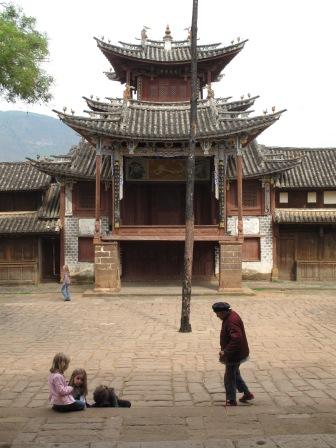 We head north in our jolly bus, along winding roads and watching kids' DVDs, to Shizhong Mountain, miles from anywhere. It has a small temple built precariously out of the cliff face. Then on to Shaxi which was an important staging point on the old tea route to Burma and Tibet. It's been beautifully preserved by a combination of a technical college in Zurich and the local council. It's also eerily quiet - totally unlike Dali Old Town. An oasis of calm - see right.
 Lunch and a wander in Dali Old Town, which used to be the capital of Dali kingdom and was pretty much independent until the last century. The French came here, up the Mekong, in the late 19th Century, and the Brits shortly afterwards from Burma. It's nicely preserved but very touristy. A bit more tranquil are the Three Pagodas, built out of brick covered in white mud around 900AD, though they've been renovated a hundred times since.
